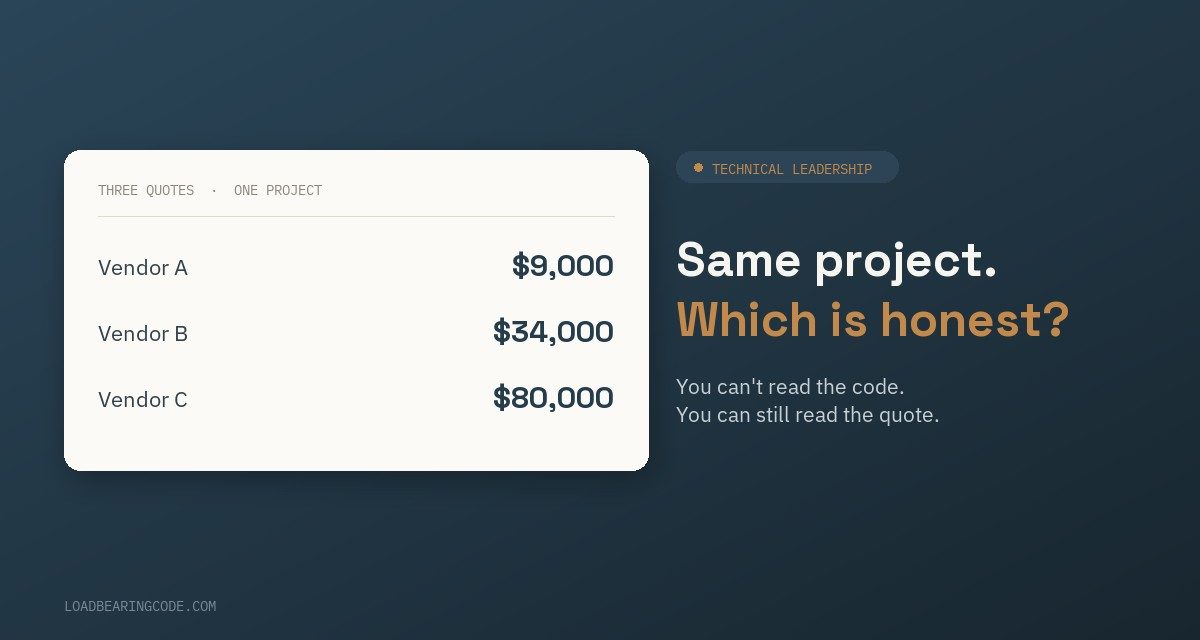
You asked three companies to quote the same project and got back $9,000, $34,000 and $80,000.
Now what? You can't read the code they'd write. You can't tell whether the expensive one is thorough or padded, or whether the cheap one is efficient or about to leave you with something half-finished. And the people best placed to explain the difference are the same people bidding for the work.
That's not a knowledge gap you should feel bad about. Nobody ever taught you this, and there's no reason you'd know it. But you can get most of the way there without understanding a line of code, and it comes down to knowing what the spread actually means.
The spread means they're not quoting the same thing
Three numbers that far apart almost never describe the same job. They describe three different guesses about what you asked for.
Whoever quoted $9,000 pictured the smallest version that could be called done. Whoever quoted $80,000 pictured the version that handles everything you might do in three years. Neither of them asked you which one you meant, because asking takes a meeting and they're bidding against two other firms who won't bother.
So the first thing to know is that you're not looking at three prices for one thing. You're looking at three different projects, and your actual job is working out which one you're trying to buy.
Why the cheapest is usually wrong
A low quote is not generosity. It's a smaller scope, and the question is what got left out.
The things that come out first are the ones you can't see on the day it launches. Testing, so problems surface before your customers find them. Documentation, so the next person can pick it up. Handover, so you're not calling the same guy forever. Any thinking about what happens when you have ten times the data you have now.
Cutting all of that is completely legitimate if you know it's happening and you've agreed it's fine. Plenty of things don't need it. What makes a cheap quote dangerous is that it usually doesn't say what's missing, and you don't know to ask, so you find out about eighteen months later when you need a change and everything grinds.
And there's a version that's worse. Some cheap quotes are cheap because the shop intends to make it back on changes. The build is a loss leader and the profit is every request after it, when you have no leverage left because they're the only ones who know how it works.
Why the most expensive usually is too
The instinct is that the priciest quote is the safe one. Sometimes. But high numbers come from two very different places and they aren't equally worth paying for.
Some of it is real. A bigger firm carries people who've solved your problem before, and you're paying for the mistakes they already made on somebody else's money. That's worth something.
The rest is uncertainty. When somebody isn't sure what they're walking into, they pad. It's a rational thing to do and it's expensive for you, because you're funding a margin for a risk nobody bothered to resolve. Half a day of somebody reading what you already have would shrink that number, and nobody spends the half day, because it isn't billable until you've signed.
You're also sometimes buying process you don't need. Project managers, account managers, ceremony. On a big build those people earn their keep. On a small one you're paying for a layer between you and the person doing the work.
The questions that sort it out
None of these need you to be technical.
Start with the most useful question anybody asks and almost nobody does: what is not included? A good answer is specific and a little uncomfortable. No testing beyond the obvious, no training for your staff, hosting is on you. A vague answer here is the loudest signal you'll get all week.
Then ask what happens when it's finished. Who owns what was built, where does it live, and could somebody else pick it up and work on it? If the answer is anything other than a clear yes, you're buying a dependency and not a thing you own.
Then ask what they're assuming. Every quote sits on assumptions about how much data you have, how many people will use it, and what it has to connect to. Get those said out loud, because that's where the change orders come from later.
And ask what happens if it runs long. Not to catch anybody out. Long projects happen. You want to know whether the number moves, who decides, and when you'd hear about it.
What good advice actually sounds like
Years ago a client asked me to make their sites faster and more resilient. The honest answer involved a third-party service that is the industry standard for it, and I could have just recommended it.
Instead I told them what it would cost them: adding it meant their sites now depended on that company staying up, and in the previous twelve months that company had eight significant outages, ranging from 25 minutes to two and a half hours. Then I said that if they wanted to go that route they could, but I wasn't making that call for them.
That's the shape of it. Real numbers, the tradeoff stated plainly, and the decision handed back to the person whose business it is. Somebody who only ever tells you what you want to hear is not on your side, and neither is somebody who makes the call for you. You want the tradeoff and the numbers, and then you want to decide.
What it costs to find out afterward
The expensive part of a bad quote is rarely the price. It's the year you spend living with what it bought.
Software you can't hand to anyone else. A vendor you can't leave. A build that technically matched the quote and doesn't do what you needed, because the gap between those two things was in an assumption nobody wrote down. None of that shows up as a line item, and all of it costs more than the difference between the three numbers you were choosing between.
The fix is cheap and it's the whole reason I offer this. Half an hour with somebody technical who has nothing to gain from which quote you pick, before you sign anything. Not to negotiate the price down. To tell you what you're actually being offered, in each of them, in plain words.
If you're sitting on a quote right now and you can't tell whether it's good, that's not a failing on your part. It's just not your job. It is somebody's, though, and it costs a lot less than the year you'd otherwise spend finding out.