Most businesses that need a code audit don't know they need one. The software works, mostly. The team keeps patching things. But something feels fragile, or slow, or scary, and nobody can quite say why. A code audit answers that question, honestly, methodically, and in plain language.
It's not a performance review of the developer who wrote the code. It's a health check on the system your business depends on.
What a code audit covers
A proper code audit looks at the system from several angles:
- Architecture. How is the code organized? Are there clear boundaries, or has everything tangled together over time? A well-structured codebase is easier to change safely.
- Security. Are there obvious vulnerabilities, places where user input isn't validated, data that isn't protected, dependencies with known holes? This is the part you can't afford to get wrong.
- Performance. Where are the bottlenecks? Which queries are slow, which pages take too long to load, where does the system struggle under load?
- Maintainability. Could another developer walk in and understand this code, or is it a puzzle only the original author could solve? If the answer is "only the original author," you have a bus factor of one.
- Technical debt. What shortcuts were taken, and which ones are now costing you? Every codebase accumulates debt; the question is whether it's manageable or compounding.
A code audit doesn't judge the past. It maps the present so you can make honest decisions about the future.
What the report looks like
A good audit produces something you can actually use: a plain-English summary of what's working, what's risky, and what to do about it. Not a fifty-page technical document that nobody reads, but a clear, prioritized list:
- Green. What's solid and doesn't need attention.
- Amber. What works but carries risk, worth fixing, but not urgent.
- Red. What needs attention now, before it causes a real problem.
Each item comes with a plain explanation of why it matters and what it'll take to address. That's the whole value: turning "we're not sure what shape this is in" into "here's exactly what we're working with."
When you need one
The most common triggers are:
- You're about to hire a new developer to take over or extend the project.
- The system is getting slower and nobody knows why.
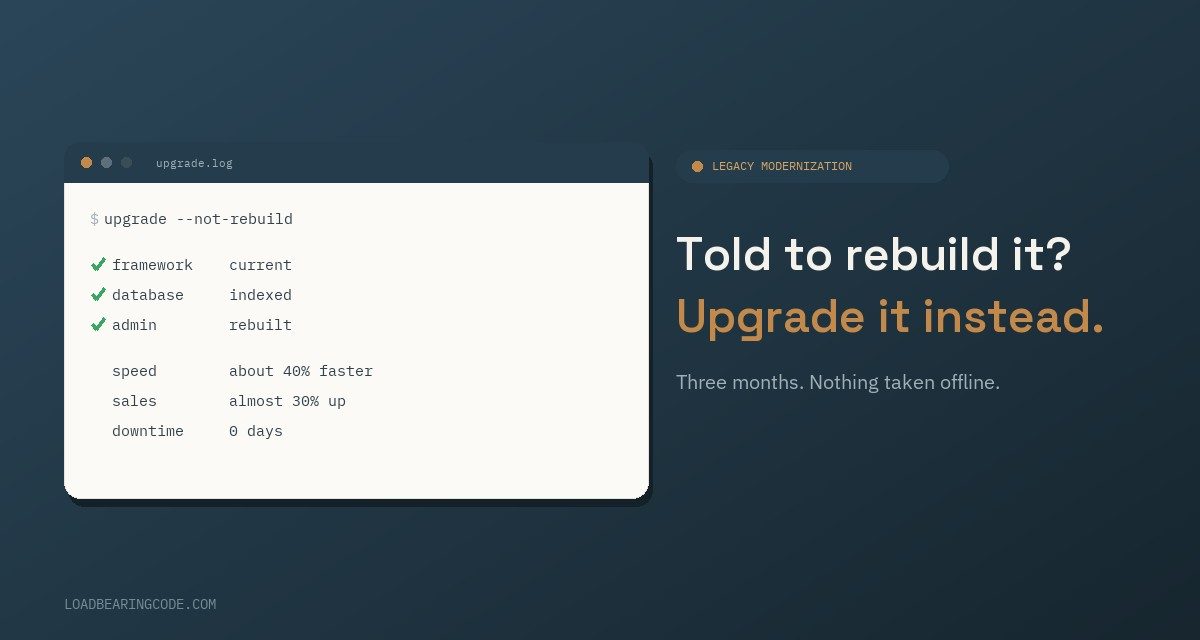
- You're deciding whether to modernize, rebuild, or leave it alone.
- Something broke and you're not sure if the fix was a bandage or a proper repair.
- You just want to know what you're sitting on, the same way you'd get a building survey before buying a house.
In every case, the audit saves more than it costs. Knowing what you have, honestly, is the prerequisite for every good decision that follows.
Servers get the same treatment, and for the same reason. I spent a day going through one this summer and found a break-in that had been sitting there for 97 days while every page loaded fine. That story is here, and a Server Audit is this same idea pointed at the machine instead of the code.